
Like, Share, Subscribe, Vote: The 2024 polls may be dubbed 'YouTube election'.

Sanjive Narain, owner of Assam's oldest news channel, and Sanjay Aditya Singh, promoter of a cabin crew training academy, are coming together to launch a regional airline providing business and premium economy services in the Northeast. Jettwings Airways will be based in Guwahati and will connect places with twin-class Embraer E175 aircraft. The airline has secured an initial no-objection clearance from the civil aviation ministry and plans to launch services in October.

High regulatory expectations and advent of discount broking have made old-style brokerage businesses unviable.

German luxury car maker Mercedes Benz on Friday said it will hike prices of its products across models by up to 10 per cent in India from next month.

TRAI on Wednesday asked service providers to ensure international mobile roaming (IMR) service is kept 'inactive' by default for all subscribers, and is activated only on explicit request by consumer, as the regulator revamped the framework to protect users from unintentional usage and consequent 'bill shocks'.

Finance Minister P Chidambaram on Monday slammed "unregulated" players in the financial market saying their activities have adversely impacted large number of consumers.

By 2023, Vistara's hangars will house a total of 70 aircraft, up from the current 42.

Driven by strong demand, the overall passenger vehicle dispatches crossed 3.35 lakh units in February as automakers, including Maruti Suzuki India, Hyundai, Tata Motors and Mahindra & Mahindra, reported robust sales during the month. The dispatches of more than 3.35 lakh units last month marked an 11 per cent over February 2022. It was also the highest ever overall wholesales in the month of February. The country's largest carmaker Maruti Suzuki India on Wednesday said its domestic wholesales rose 11 per cent to 155,114 units in February as compared with 140,035 units in the same month last year.

In the recent past, Adityanath and the RSS seem to have come closer. The warmth is more on the part of the RSS. And even now, not all requests from the RSS are accommodated by the UP government, points out Aditi Phadnis.

Brokerage Edelweiss Securities said if the NDA returns to power with a clear majority in line with exit polls, markets would rejoice the policy continuity.

The Indian Railways must opt for a dynamic fare-fixing system and improve its management and marketing techniques.

It is ideal for someone looking to have the practicality of a diesel and the utility of an automatic.

The antiviral drug may cost around Rs 55,000 for an 11-dose course, or Rs 5,000 per injection -- much less than the price of imports from Bangladesh, reports Sohini Das.

What are the upcoming locations and pull factors that determine housing prices in these two metros? What does this means for a buyer?
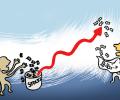
'If I had to highlight one area that will do well, it is the financial assets -- that is the private sector banks, insurance and mutual funds.'

The EV industry is at an inflection point and batteries will play a critical role ahead -- batteries and related components typically constitute 35-45 per cent of an EV's costs.

Following the outbreak, Iran has stopped Indian basmati shipments. This has led to exports already falling 18-20 per cent this fiscal year. Iran and the rest of West Asia account for the largest imports of Indian basmati, and comprise more than 30 per cent of the shipments.
Exactly a fortnight ahead of the Reserve Bank of India's (RBI's) next monetary policy review, a key market indicator of interest rates - the overnight indexed swap (OIS) - suggests that the central bank may tighten policy by 35 basis points and then refrain from further rate hikes. RBI Deputy Governor Michael Patra recently described the OIS as the primary instrument for hedging interest rate risk in India. The six-member Monetary Policy Committee (MPC) of the RBI will meet on December 5-7.

For rest of the year, the issue is largely going to be the balance between growth rates and macro stability versus interest rates, says Sankaran Naren.

India's urban unemployment rate declined in Q4FY23 to 6.8 per cent - the lowest in over four years -- after it stagnated at 7.2 per cent in the previous October-December quarter, reflecting improvement in the labour market, according to the Periodic Labour Force Survey (PLFS) released by the National Statistical Office (NSO) on Monday. The unemployment rate in current weekly status (CWS) terms for all ages in the March quarter was the lowest recorded in more than four years, from the time the NSO released India's first quarterly urban jobless rate for the December quarter in 2018. The jobless rate in urban areas had been on a continuous decline since the peak of 20.8 per cent in the April-June quarter of FY21.

'They can transition from short to long-duration funds when the yield curve normalises.'

Indian IT services companies have seen several CEO changes that have, over the past few months, led to some crucial exits at the mid-senior level in a trend that is likely to continue. According to a recent Motilal Oswal report, "Movement of mid-to-senior leadership at IT services firms is a reality, partially on account of multiple CEO-level changes.

Lenovo, Xiaomi, Vivo, Gionee lead the onslaught, beating Indian and global brands with smart deals and astute image management measures.

German machine tool exports to India have been growing at double digit figure since 2002. Moreover, German exports saw an increase of 23 percent in the first half of 2007 compared to the same period last year, Chairman of VDW, the German Machine Tool Builders' Association, Carl Martin Welcker said on Thursday.

By the end of 2017, the Chinese firm had emerged as the fastest growing brand after posting 343 per cent growth with 19 per cent market share for the full year.

Irdai on Friday extended the 'use and file' procedure for the most of the life insurance products, thereby allowing insurers to launch new products without prior approval of the regulator. This comes days after Insurance Regulatory and Development Authority of India (Irdai) extending similar relaxations to health insurance products as well as general insurance covers. In a press release, Irdai said that in its continuous endeavour towards the reform agenda taken up towards having a fully insured India, it has extended the 'use and file' procedure for most of the life insurance products.

Capital markets regulator Sebi has permitted mutual funds to again invest in foreign stocks within the aggregate mandated limit of $7 billion for the industry. This came in the wake of a major correction in global markets that brought down the valuation of international stocks. In January, Sebi had asked mutual fund houses to stop taking fresh subscriptions in schemes investing in overseas stocks. The directive to stop subscription was mainly on account of the mutual fund industry crossing the mandated limit of $7 billion for overseas investments.

Bank shares were the top losers after sharp gains last week.

With banks staying out of the bond market, and foreign investors exhausting their investment limit, the question is: Who will buy the Rs 4.6 trillion bonds that will be issued from April.

With the government reducing the net worth for new entities in fuel-marketing space to Rs 250 crore, the market is open for new players like Total, Adani, and Saudi Aramco -- and even supermarkets - to open fuel outlets.

In an interaction with Viveat Susan Pinto, Thomas Lutz, head of the consumer and retail practice at The Boston Consulting Group. highlights some of the top consumer trends in India and the way forward for companies.

'2022 has not been -- and will not be -- the kind of 2021 bull market, which lifted all boats.'

Defence public sector undertakings (PSUs) have been asked by the Centre to hold roadshows in Dubai and Abu Dhabi to share their financials and business plans to reel in investors. Hindustan Aeronautics (HAL), Bharat Dynamics (BDL), Bharat Electronics (BEL), Garden Reach Shipbuilders & Engineers (GRSE), and Mishra Dhatu Nigam (MIDHANI) have informed stock exchanges that they will conduct investor outreach programmes and participate in 'non-deal' roadshows and meetings with prospective investors from September 12-15. They will share their short- and medium-term growth plans, financial metrics, improvement in their stock performance/ market capitalisation - and make a pitch of sorts to prospective investors.

Reliance Industries Ltd will acquire German firm Metro AG's wholesale operations in India for Rs 2,850 crore as the conglomerate run by billionaire Mukesh Ambani seeks to strengthen its dominant position in India's mammoth retail sector. "Reliance Retail Ventures Limited (RRVL), a subsidiary of Reliance Industries Ltd, signed definitive agreements to acquire a 100 per cent equity stake in Metro Cash & Carry India for a total cash consideration of Rs 2,850 crore, subject to closing adjustments," said a joint statement. Through this acquisition, Reliance Retail will get access to a network of Metro India stores located in prime locations across key cities, along with a large base of registered kiranas and other institutional customers, and a strong supplier network.
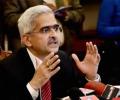
Reserve Bank Governor Shaktikanta Das on Wednesday pitched for higher investment in infrastructure and reforms in labour and product markets to achieve sustainable growth post-pandemic. Addressing AIMA National Management Convention, Das underlined the need for increased investment in healthcare education, digital and physical infrastructure to ensure sustainable growth and generate employment opportunities.

Lamborghini is focusing on bringing its new car models to India faster after the global launch of its Huracn Tecnica, its country head Sharad Agarwal said on Thursday, adding there is a lot more scope for the company to expand in tier I and II cities. "Typically, in the premium and luxury car segments, there is a lag of six to 18 months between a global launch and India launch," he said in an interview to Business Standard. The Italian carmaker launched the two-seater track-focused performance car - the Huracn Tecnica - here on Thursday four months after its global unveiling.

Debt as an investment avenue for the wealthy has been attracting more assets than equity. The portfolio management service (PMS) industry, whose services require a minimum investment of Rs 50 lakh, has seen a 4.4 per cent decline in equity assets since March 2022.

Gold exchange traded funds (ETFs) witnessed a net outflow of Rs 199 crore in January, making it the third monthly withdrawal in a row, with investors preferring equities over other segments on buoyant record SIP flow. This was in comparison to a net outflow of Rs 273 crore registered in the segment in December and Rs 195 crore in November. Prior to that, Gold ETFs attracted Rs 147 crore in October, data with Association of Mutual Funds in India (Amfi) showed.

Modi made the comments in his address after inaugurating the 14th edition of Aero India at the Yalahanka Air Force station complex on the outskirts of Bengaluru.

Walmart, the world's largest retailer, has paid $1.4 billion to buy out US-based Tiger Global's investment in e-commerce firm Flipkart, according to sources. The transaction puts Flipkart's valuation at $35 billion, against nearly $38 billion in 2021 when it raised funds from Japan's SoftBank, Walmart, and other investors. Tiger Global, Flipkart co-founder Binny Bansal, and Accel now have all fully exited the e-commerce firm by selling their stake to Walmart.
